Website Redesign.
Your business grows and evolves. Your website should reflect that progress.
Show us your current site and tell us what you would like to change. We start from there.
When a website needs redesigning
Sometimes it is the look that has fallen behind. Sometimes it is the navigation, the speed, or a structure that no longer fits the business. A redesign starts by identifying what isn’t working as it should.
Your website looks outdated.
A dated look shapes the first impression visitors form of your business, before they even learn what you offer.
The business has changed. The website hasn’t.
When the site still describes the business as it was years ago, visitors form an impression of something that no longer exists.
It doesn’t read well on a phone.
Small tap targets, text that needs zooming, a menu that hides what matters. For many visitors, the phone is their first contact with your business. The experience should be just as considered as it is on a desktop.
Visitors struggle to find things.
Over time, the way content is organised can become complicated, making it harder for visitors to find their way around.
Outdated technology is holding you back.
An outdated technical foundation can make the site harder to maintain and limit how far it can evolve.
Visitors arrive, but enquiries don’t follow.
The traffic is there, but enquiries and bookings don’t follow. Often the issue isn’t how many people arrive but what they find: an unclear message, a hidden next step.
Recognising one of these doesn’t automatically mean you need a new website. It means the current one deserves a careful look.
Castello Boutique Rooms
From a standard location map to an interactive way of exploring the city.
For Castello we designed a map that shows the beaches around Kavala, how far each one is from the rooms, and how close the port is. The map makes exploring the surrounding area part of the experience, giving potential guests a glimpse of what awaits them during their stay.
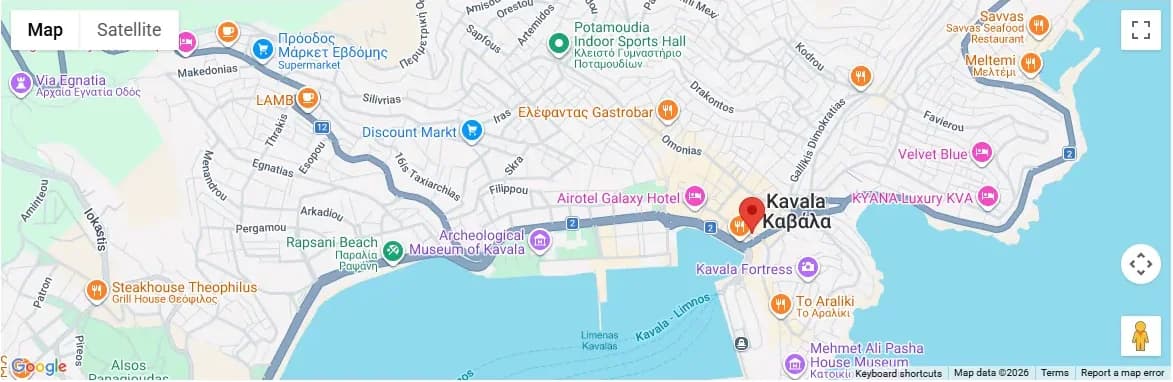
Before
A standard embedded Google Map.
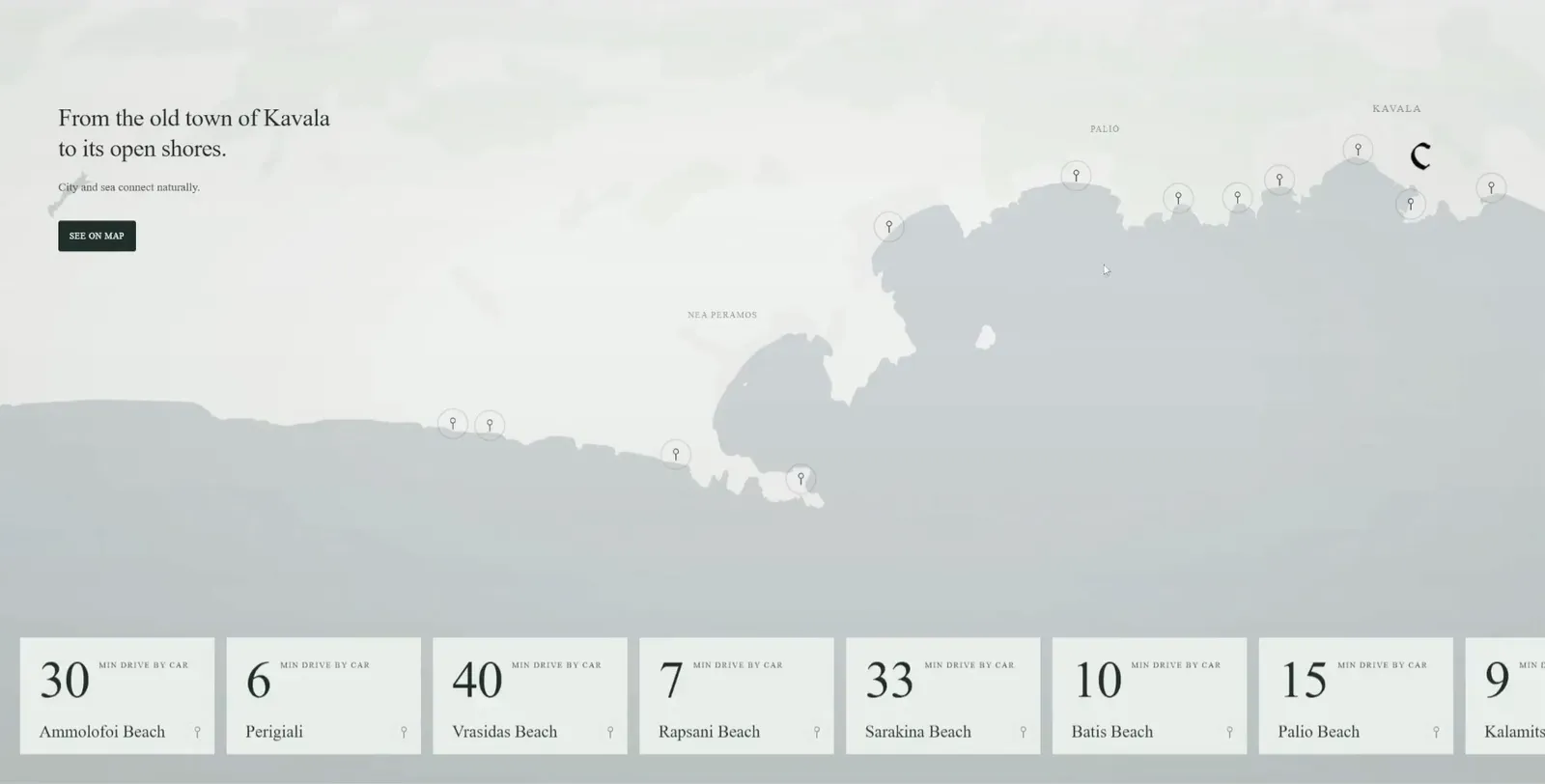
After
View the Castello Boutique Rooms case study“The result captures exactly the feeling we wanted our hotel to convey. Calm, considered and much closer to the level of experience we offer.”

Before

After
What stays and what changes
A redesign doesn’t start from a blank page. It starts from a site with a history, and before anything changes we decide what is worth keeping.
What we evaluate first
- Content
- Copy that answers real questions is carried across and edited, not rewritten for the sake of it.
- Features
- Bookings, forms, catalogues, connections to other systems. They are listed from the start, so the new site doesn’t forget something the old one did quietly.
- Identity and material
- Logo, colour, photography, tone of voice. Whatever still represents the business stays and gets a better setting.
- Search visibility
- Pages that already bring visitors are identified before design begins. How they are protected is explained below.
Redesigned
- Visual identity
- Typography, colour, composition and motion that match where the business is today.
- Structure and navigation
- Which pages are needed, the order they are read in and where they lead, based on what visitors are actually looking for.
- Every screen
- Phone, tablet and wide screen are designed as distinct compositions, with accessibility built in.
- Speed and content management
- A fast, stable foundation, with content management where something changes often.
Redesign or rebuild?
Redesign
Focuses on how the website looks and how it is used. It covers the aesthetics, the organisation of content and the navigation, aiming for a presence that represents the business better and serves its visitors well.
Rebuild
Focuses on how the website works technically. It involves upgrading or replacing the existing technology, aiming for better speed and security, easier management and room to grow.
The right approach depends on the needs and the condition of the current website.
When is each one needed?
- When the look no longer represents the business.
- The website may still work properly from a technical point of view. Here the priority is renewing its aesthetics and user experience.
- When the technology creates limitations.
- The look may still be satisfactory, but the site is slow, hard to manage or has technical problems. Then its technical foundation needs upgrading or replacing.
- When the business’s needs have changed.
- New services, a different audience or greater demands may call for a full review of content, design and functionality.
At Workflows, the rebuilds we take on are usually delivered as new, custom websites built with Next.js. We always assess the existing site first, so we can keep what still serves the business and propose only the changes that are genuinely needed.
Stogiannis Winery
From a black-and-white website to a presence with colour, character and a collection that can grow.
Visual identity
The old site was essentially black and white, with no colour identity of its own. The new one takes its palette from the region itself: the burgundy of the wine, the green of the vineyard, the stone and cream of the landscape. Photography of the vineyard and the region carries most of the visual weight.
Content architecture
On the old site, individual wines had no pages of their own. The new site is built on a shared structure, in Greek and English. The content guides visitors from the region and the winery to the wine collection. Each wine has its own dedicated page, allowing the collection to grow without restructuring the website.
View the Stogiannis Winery case study“The new presence represents us more fully and with greater confidence. We feel the site now truly reflects who we are.”


Protecting the presence you already have in Google
A website that is already live may have built up significant organic visibility. Redesigning it takes careful planning, so that the value built over time is preserved.
Existing pages may rank for important searches, attract organic traffic and receive links from other websites. Changes to their content, structure or URLs, without proper planning, can negatively affect the site’s search visibility.
That is why the SEO migration starts in the earliest stages of the project and continues after the new site goes live.
Before the redesign
- We examine which pages appear in Google, and for which searches.
- We analyse organic traffic and links from other websites.
- We identify the content and addresses worth keeping.
During the migration
- Redirects: When a page’s address changes, we apply a permanent (301) redirect to the new, equivalent page.
- Canonical URLs: We define the main address of each page, so search engines recognise its correct version.
- Technical checks: Before launch, we check the structure, internal links, sitemap and indexing settings.
After launch
- We monitor how the new pages are indexed through Google Search Console.
- We find and fix errors, broken links and faulty redirects.
- We compare organic traffic and rankings with the data from before the migration.
What we can’t guarantee
Redesigning a website can temporarily affect its rankings in Google. Search engines need time to evaluate the changes, so organic traffic may fluctuate.
Our aim is to limit these risks through sound planning, a careful migration and ongoing monitoring.
To improve your organic presence over time, see how we approach SEO.
Our Redesign Process
Unlike building a new website, a redesign starts by assessing the existing one. We understand what works and what needs improving, and plan the next steps.
Understanding
We talk about what has changed in the business and review the current site: content, features, performance, technical foundation.
Direction
We agree what stays, what changes and the scope of the project, before anything is designed.
Design
The new design is presented and refined with your feedback, on the structure we agreed.
Build and testing
Development, content migration and testing on a staging site, while your current site keeps running.
Launch & Transition
The new site replaces the old one. Over the following weeks we check that everything works as it should.
Frequently asked questions
Let’s see what could be better.
Tell us where the business is today and what isn’t working on its website. We’ll tell you what is worth changing, and what isn’t.